Italian Ceramic Towns to Visit: Faenza, Deruta, and Vietri for Potters
Three towns, three different ideas about what a pot is for. In Faenza, pottery is a subject you can study for a week and still not exhaust. In Deruta, it is a family business measured in generations and kiln loads. In Vietri sul Mare, it climbs the walls of churches and wraps the facade of a factory. Potters usually arrive in one of these places by accident — a rainy afternoon, a detour on the way somewhere else — and leave with a notebook full of things to try at the wheel. What follows is a working guide to all three, written for people who care how a glaze breaks on a rim.
Faenza: The Town That Named the Craft
English speakers use the word faience; the French say faïence. Both come from this small Romagna town, which has been exporting decorated tin-glazed pottery since the Middle Ages. That history is not sealed behind glass. Faenza still has working workshops, a ceramics school and a September market that fills the piazzas with stands — enough to keep a potter occupied for two full days.
The anchor is the Museo Internazionale delle Ceramiche, one of the most substantial ceramics collections in Europe. It runs from ancient Mediterranean wares through Renaissance istoriato plates to twentieth-century studio work, and the cases of Italian maiolica are worth the trip on their own.
What to study inside
Go with a purpose rather than strolling. Three things repay close looking: the borders on sixteenth-century plates, where a single repeating motif is varied at the corners so the pattern turns without a stumble; the backs of dishes, often as carefully painted as the fronts; and the historical test pieces, which show how a workshop thought about a glaze before committing a whole kiln to it. Sketch two or three borders by hand. Photographs flatten the line quality; your own pencil will not.
Check opening days before you go — Italian museums commonly close one weekday, and this one is no exception. Mornings are quieter.
Deruta: Lustre, Brushwork and Family Kilns
Deruta sits on a hill outside Perugia, and its reputation rests on two things: maiolica painted at speed, and lustre — the metallic gold and ruby sheen made here since the Renaissance. You will see the pattern books before you see the kilns. Shop after shop carries the same vocabulary of dragons, racemes and amorini, which is exactly the point: a Deruta decorator can paint a plate in a rhythm learned over years, then paint it again two hundred times.
Walk the historic centre and the workshops along the road below it. Many are family operations with a showroom at the front, a bench in the middle and a kiln at the back. The regional ceramics museum holds a good collection of lustre and makes a sensible first stop, because the finish is easier to recognise once you have seen it under glass.
Try lustre without wrecking your kiln
Lustre is fired over an already-glazed pot, at low temperature, in a heavily reducing atmosphere — the kiln is packed with smoking organic material and the metal-bearing compounds in the lustre paint are drawn into a thin film on the glaze. Results vary even for people who have done it for decades. If you want to test it at home, keep a small kiln for lustre alone, fire outdoors or under proper extraction, and read the safety data sheets for the products you buy. These materials are not something to handle casually; gloves, ventilation and a separate firing schedule are the minimum. Ask a supplier or an experienced technician before your first attempt.
Vietri sul Mare: Colour at Building Scale
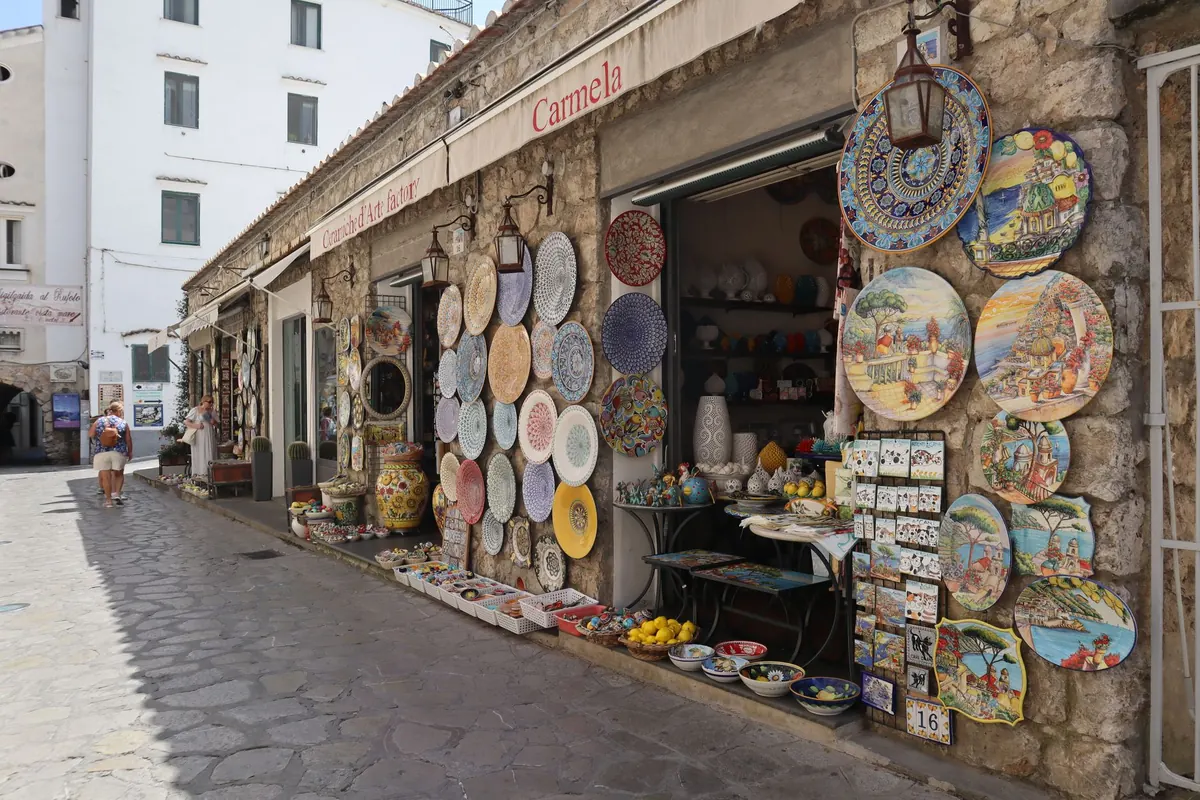
Vietri is the first town on the Amalfi Coast road out of Salerno, and it is the most architectural of the three. Majolica covers the dome of the church of San Giovanni Battista, runs up the walls of stairways and clads a famous ceramics factory in thousands of irregular discs. The town's modern character owes something to the northern European artists who settled here between the wars and pushed local workshops toward flat, graphic pattern and saturated colour.
For a potter, the lesson is scale. A pattern that works on a 20 cm bowl can fall apart on a 60 cm planter, and Vietri's best work solves that with confident drawing and generous spacing. Look at how the joins on large planters are handled, where a pattern is deliberately interrupted, and how much white glaze is left empty so the colour sings in bright coastal light.
A short walking route
- Start at the church dome for an overview of the local palette.
- Follow the ceramic staircase into the older streets and watch how the pattern changes with distance.
- Walk the coast road to the factory facade and look at it from close up and from across the street.
- Finish in the workshops, where you can compare hand-painted repeats with decal work — the difference usually shows on the second look.
Three Lessons, One Notebook
- From Faenza: copy a museum border onto a test tile and see whether your brush can hold the same rhythm.
- From Deruta: choose one brush and paint the same leaf fifty times, then plan a small lustre firing in a dedicated kiln.
- From Vietri: design a pattern for a form four times larger than the one you usually make.
Working While You Are There
None of these towns is a theme park, and the workshops are businesses. Write ahead if you want bench time; a short email in Italian or English asking about a half-day session usually gets an answer, while turning up at the door on a firing day will not. Small studios are most receptive outside the summer peak.
Buy from the workshop rather than the souvenir shop, and ask about seconda scelta — seconds. They cost less and teach you more, because a misfired lustre or a crawled glaze shows exactly where a process is fragile. Resist the urge to ship clay bodies home; the weight is rarely worth it. A notebook, a few test tiles and one or two small pieces travel better. If something large does catch your eye, ask about packing and shipping before you commit.
Putting the Trip Together
Rail makes this easy. Faenza sits on the Bologna–Rimini line and is a short